Gemini Omni 1.2 Flash: 15-Second Video, 30% Cheaper
Share: https://www.ellixorlabs.com/blog/gemini-omni-1-2-flash-15s-video-pricing (copy URL for iMessage or social)
Published (display in IST)
Updated (IST)
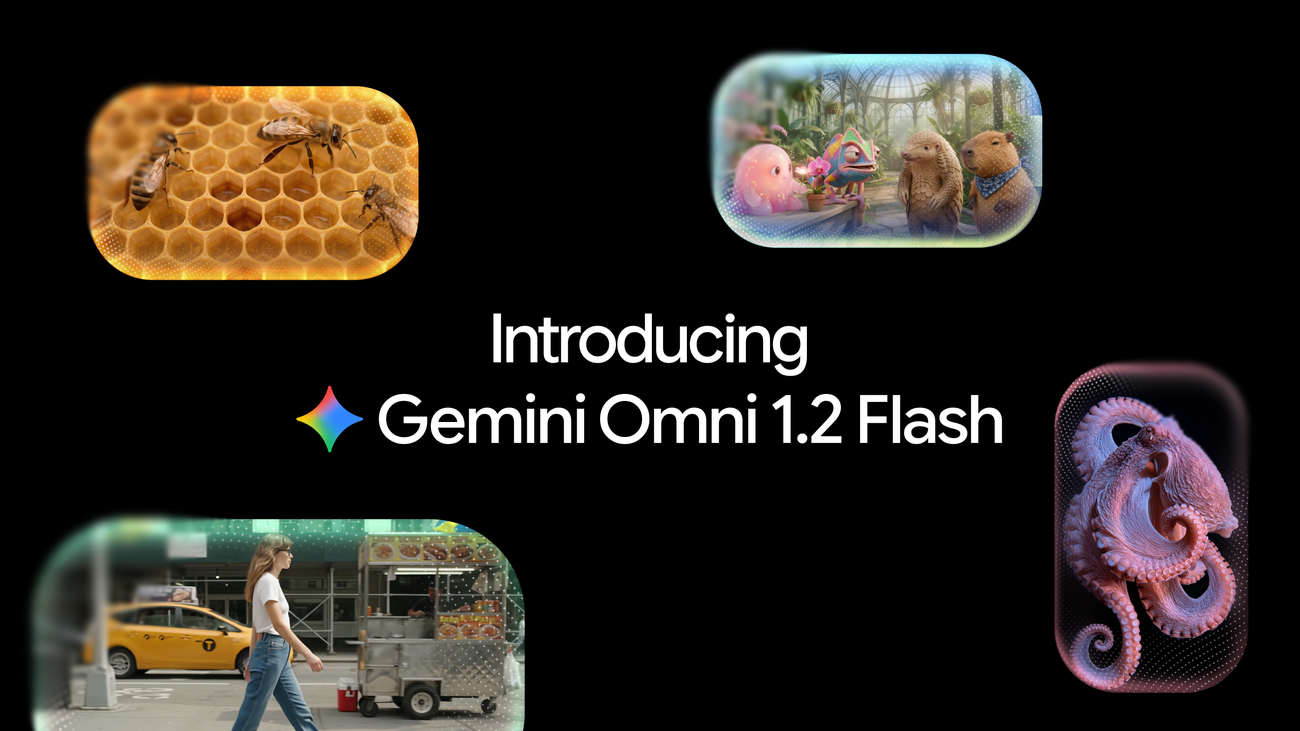
Google made Gemini Omni 1.2 Flash generally available with native 15-second clips, multi-turn editing and a 30% cut that brings 720p video to about $0.07 per second.
Image: Google / The Keyword. View source.
Google cut the price of its flagship AI video model by 30% and stretched native clips to 15 seconds. On 5 November 2026, Google DeepMind launched Gemini Omni 1.2 Flash as generally available on the Gemini API and Google Cloud, with multi-turn conversational editing and stronger reference following for product and brand work.
In short, Omni 1.2 Flash is live for production use at about $0.07 per second for 720p video, you can generate and edit clips from 3 to 15 seconds, and every API output carries Google's SynthID watermark. For founders building ads, explainers or product demos, that combination of length, price and general availability is the news.
What Google launched in Omni 1.2 Flash
The headline change is length. Native generation and editing now run up to 15 seconds, up from 10 seconds on Omni 1.1, with duration selectable in one-second steps from 3 to 15 seconds. Google says that window is meant for complete stories, product explainers and full social ad spots in a single generation, according to The Keyword.
Editing is the other practical shift. Instead of regenerating a whole clip after a small change, you can refine the same clip turn by turn: swap a product or background, change lighting or weather, or switch aspect ratio while keeping the rest intact. Google also highlights stronger reference adherence, so faces, garments, packaging typography and brand colours stay more consistent across camera angles when you combine character, product or style images with short motion clips and audio cues.
Workflow tips Google emphasises include drafting at 360p or 720p, fixing details with follow-up edits rather than full regenerations, then upscaling selected results to 1080p or 4K. Speech, lip-sync and continuous camera moves also get explicit upgrades in the announcement, though Google notes ongoing work on fast sports action, rapid script changes and complex physics.
Meet Gemini Omni 1.2 Flash, our updated video generation model from @GoogleDeepMind. Get stronger consistency, more creative control, and faster, more cost-effective video creation at scale: Fast and 30% lower cost: Draft at 360p or 720p ($0.07/s) and upscale to 1080p or 4K
Posted by @Google on X, 5 November 2026
Pricing, availability and how it compares
Google says 720p pricing dropped 30% from Omni 1.1 to about $0.07 per second. The Gemini Developer API pricing page lists the model id as gemini-omni-1.2-flash on the paid tier only, with input at $1.50 per million tokens and video output at $12.00 per million tokens. Billing is metered at 5,792 tokens per second of 720p video, which Google equates to roughly $0.70 for a 10-second clip and $1.04 for a 15-second clip.
Other resolutions scale with token rate. Google lists about $0.023 per second at 360p, $0.104 per second at 1080p with upsampling, and $0.209 per second at 4K with upsampling. Text output is $9.00 per million tokens. Omni 1.1 Flash remains listed meanwhile at about $0.10 per second for 720p video.
Compared with the previous generation, the meaningful deltas for builders are longer clips, lower per-second cost, general availability with Provisioned Throughput on Google Cloud, and the December migration path. From 3 December 2026, requests to gemini-omni-1.1-flash automatically route to 1.2 and bill at 1.2 rates, so existing integrations get a defined cutover without an immediate rewrite.
Independent public leaderboard scores for Omni 1.2 Flash were not published in Google's launch post, so treat quality claims as company-reported. For a parallel look at how image models are shipping into chat and API products this week, see our note on OpenAI Images 2.6.
What it means for builders and creators
If you sell products online, run a lean marketing team or ship software that needs short video, a 15-second, API-ready clip at roughly a dollar changes the unit economics of testing. You can draft cheaply at lower resolution, iterate in conversation, then upscale only the winners. That matters more than another demo reel when your budget is measured in rupees or a small SaaS runway.
General availability also reduces the usual early-adopter risk. Google Cloud enterprise infrastructure, security controls and Provisioned Throughput are part of the GA story. Still, plan for safety filters, English-first API support, and the limits Google lists around sports, complex physics and unsupported voice or uploaded-audio editing. If you are weighing when to bring automation into your stack, our guide on when to hire AI and automation is a practical checklist, and Ellixor's services cover product and content systems that need reliable media pipelines.
Distribution is broad. Developers can prototype in Google AI Studio and call the paid Gemini API. Creators get Flow for scene direction, longer clips in Google Vids at no additional cost with a Google account or Workspace subscription, Gemini app access rolling out to Google AI Ultra for 15-second clips, and campaign tools in Google Ads. That spread sits beside other recent model moves, including open-weight releases such as Kimi K3.1 Pro, so teams should pick tools by latency, licensing and cost per finished asset, not by brand alone.
What to watch next
Three dates and signals matter. First, the 3 December 2026 auto-route from Omni 1.1 to 1.2: confirm your billing alerts and eval harnesses before then. Second, independent quality comparisons once third-party labs publish Omni 1.2 numbers. Third, whether Google expands language support and audio reference editing beyond the current allowlisted or unsupported paths.
If you already generate product or social video with AI, run a small A/B on Omni 1.2 Flash this week: same brief, 10-second versus 15-second outputs, draft-then-upscale versus one-shot 1080p, and measure cost per usable clip plus brand consistency. That experiment will tell you more than any launch post. Questions about wiring video generation into a site or ops stack? Get in touch.
Frequently asked questions
What is Gemini Omni 1.2 Flash and when did Google launch it?
Gemini Omni 1.2 Flash is Google DeepMind's video generation and editing model. Google launched it on 5 November 2026 and made it generally available on the Gemini API and Google Cloud, with native clips up to 15 seconds and a 30% price cut versus Omni 1.1.
How much does Gemini Omni 1.2 Flash cost on the Gemini API?
On the paid Gemini API, video output is billed at $12 per million tokens, which Google equates to about $0.07 per second at 720p (roughly $0.70 for 10 seconds and $1.04 for 15 seconds). Input tokens cost $1.50 per million. The model is not on the free tier.
What happens to Gemini Omni 1.1 Flash after this release?
Gemini Omni 1.1 Flash stays available during a transition. From 3 December 2026, API requests to gemini-omni-1.1-flash automatically route to gemini-omni-1.2-flash and are billed at the lower 1.2 rates, according to Google's pricing docs.
FAQ
What is Gemini Omni 1.2 Flash and when did Google launch it?
Gemini Omni 1.2 Flash is Google DeepMind's video generation and editing model. Google launched it on 5 November 2026 and made it generally available on the Gemini API and Google Cloud, with native clips up to 15 seconds and a 30% price cut versus Omni 1.1.
How much does Gemini Omni 1.2 Flash cost on the Gemini API?
On the paid Gemini API, video output is billed at $12 per million tokens, which Google equates to about $0.07 per second at 720p (roughly $0.70 for 10 seconds and $1.04 for 15 seconds). Input tokens cost $1.50 per million. The model is not on the free tier.
What happens to Gemini Omni 1.1 Flash after this release?
Gemini Omni 1.1 Flash stays available during a transition. From 3 December 2026, API requests to gemini-omni-1.1-flash automatically route to gemini-omni-1.2-flash and are billed at the lower 1.2 rates, according to Google's pricing docs.
Talk to Ellixor Labs about this topic.
Source: Google The Keyword